Saudi Arabia
AI call center and contact center software for Saudi Arabia
Banks and finance companies, telecom operators and resellers, collections floors, insurers, clinics and the BPOs that serve them run inbound queues and outbound campaigns from one platform, in Gulf Arabic and English, on their own Saudi SIP trunks and their own caller IDs.
14-day free trial · no credit card required
Quick answer
What you get
Everything in one workspace
Gulf Arabic that survives the call and the export
AI answering machine detection, transcription with AI summaries, Arabic-aware live sentiment and an RTL agent desktop, with 11 languages across the platform and PDF exports that keep Arabic readable.
KSA CST jurisdiction pack
The Kingdom ships as a pack, so a floor that also dials the UAE, Jordan or Bahrain configures each rulebook from a pack rather than from memory. The rule that applies follows the number being called.
Consent records with provenance
Consent is created, updated and revoked per contact with its type, source and timestamp. The PDPL Implementing Regulation requires consent to be documented so it can be verified later, with a separate consent per purpose.
BYOC with your own carriers
Connect the SIP trunks you already contract in Saudi Arabia, or take trunks and numbers from BroadNet. Patterns that keep the voice on your own trunks carry no per-minute platform fee.
Local caller ID, owned by one tenant
Telecom Act Bylaws Article 55.9(a) requires the agent to disclose, at the start of the call, the provider the call is made for and its purpose. DialerBee assigns caller IDs per campaign with exclusive ownership, so a number belongs to one tenant and cannot be presented by another.
Calling hours and do-not-call
Saudi Arabia publishes no permitted-hours rule for outbound voice calls: the 22:00 to 07:00 window that is often quoted sits in the anti-spam regulation, whose definition of an electronic message excludes voice calls. DialerBee makes the window you choose a setting, applied on every campaign against a single UTC+03:00 zone with no daylight saving, with a record of what was in force.
WhatsApp and SMS in the same thread
Text, approved templates, images, documents, location, interactive buttons and lists, with replies landing against the same contact. Voice, WhatsApp and SMS share one consent and suppression record, so an opt-out on one applies to the others.
Inbound queues and IVR in Arabic
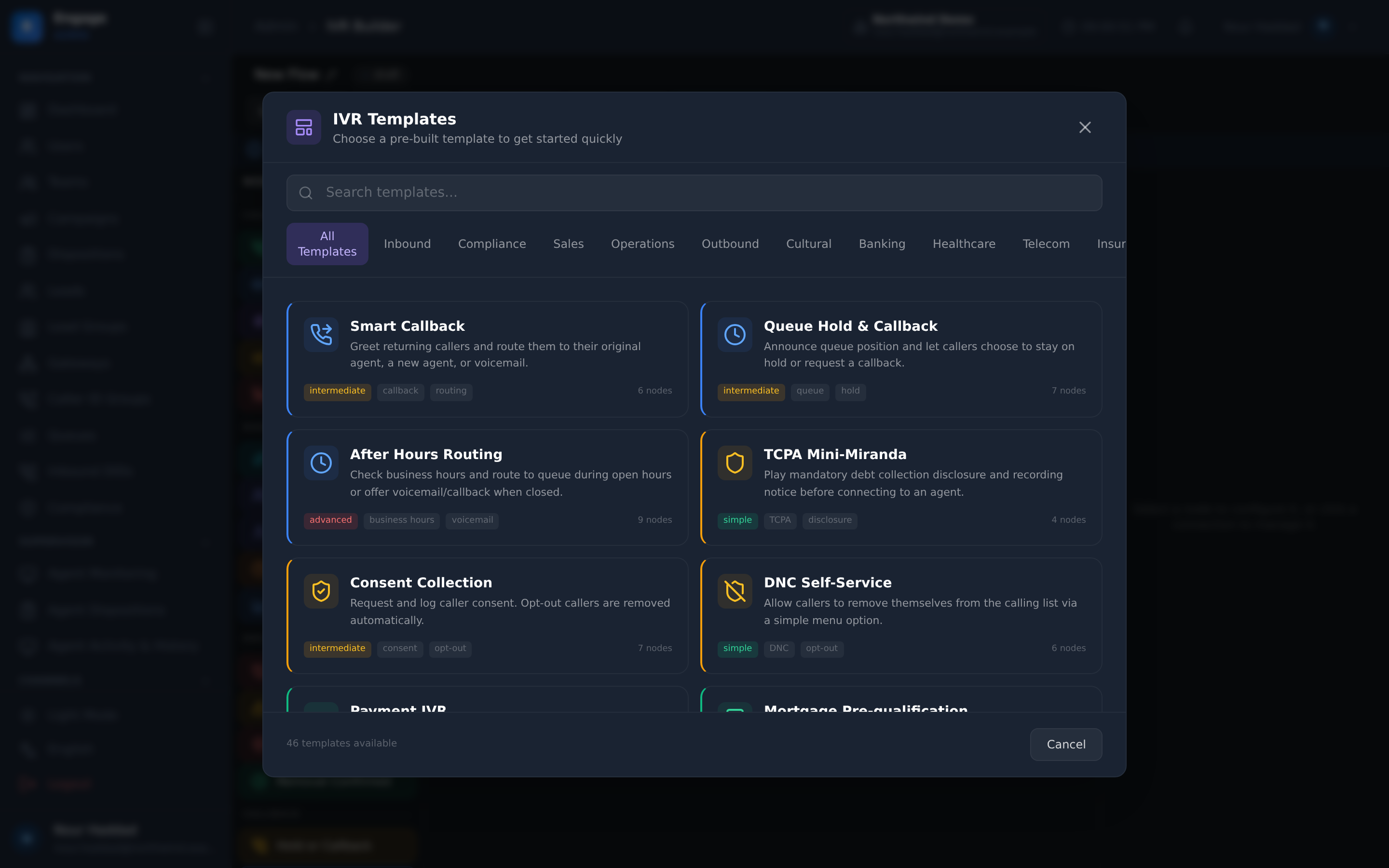
ACD queues route by FIFO, round-robin or longest-idle, each with its own SLA target and breach threshold. The IVR builder lets a caller check or change a booking, request a callback and keep their place, hear queue position or choose a language, with prompts in Arabic.
Layla, the AI voice agent
Layla answers inbound calls routed from a DID, runs outbound AI campaigns, books and reschedules appointments after a free-busy check, quotes only prices from your own service catalogue, and hands off to a human agent. Gulf Arabic, alongside ten more languages.
One tenant per client
Multi-tenant and white-label, so an outsourcer keeps each client on its own tenant with its own rules, suppression lists, caller IDs, reporting and branding. Row-level isolation is enforced in every service.
Local compliance
Who regulates outbound calling in Saudi Arabia
Saudi outbound calling is regulated by the Communications, Space and Technology Commission, renamed from CITC on 10 November 2022, with personal data supervised separately by SDAIA under the Personal Data Protection Law. The consent model is prior opt-in, documented so it can be verified later and separated by purpose. No national do-not-call register appears in the published instruments, so the duty is a free, easy stop mechanism at the sender.
Two things are commonly misquoted. There is no published permitted-hours rule for outbound voice, and recording starts from a prohibition rather than a permission: the Telecommunications Act makes calls over public networks confidential and bars recording except in the cases set out in the regulations. DialerBee provides compliance-supporting controls, not a compliance guarantee, and your own counsel remains the authority on your obligations.
This page is for operational education only and is not legal advice. Regulations change, and DialerBee provides compliance-supporting controls rather than a compliance guarantee. Confirm current rules with the Communications, Space and Technology Commission (CST), renamed from CITC in November 2022 and qualified counsel before you launch.
The floor
One desktop for inbound and outbound
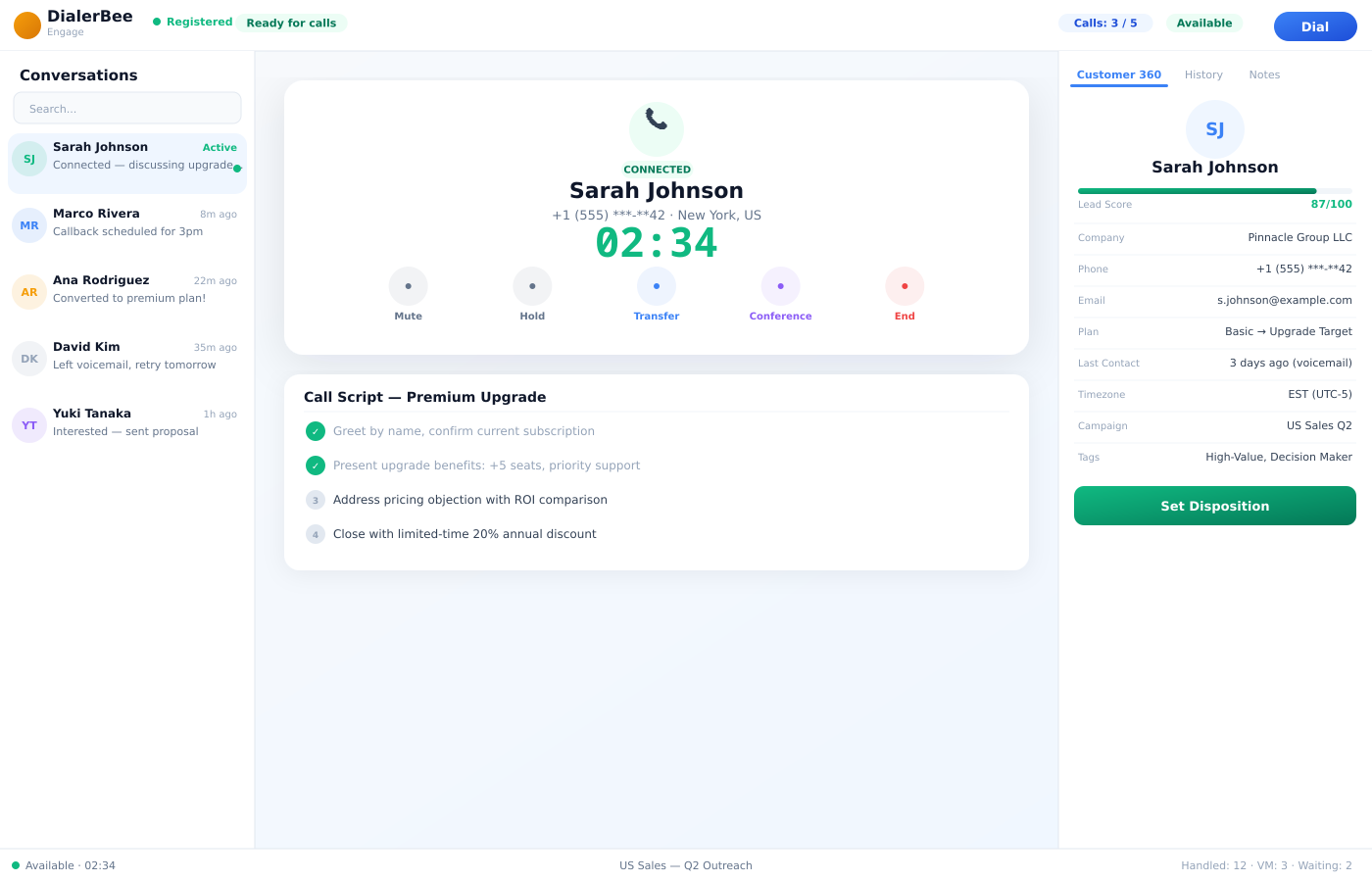
Agents in Saudi Arabia take queue calls and run campaigns from the same browser desktop, with WebRTC rather than a handset on every seat. The customer record opens with the call, keyed on the phone number, with profile, history, notes and a CRM tab beside it.
Live agent assist builds a summary while the call is running, reads sentiment, and suggests a response and a disposition the agent confirms or ignores. One seat covers inbound and outbound, so an agent who takes queue calls and dials campaigns is billed once.
- Browser-based WebRTC agent desktop, no handset or VPN per seat
- Screen-pop with the customer record by phone number, and a CRM panel beside it
- Live summary, sentiment, suggested response and suggested disposition
- One per-agent seat covers inbound queues and outbound campaigns
Inbound
Queues and self-service in Arabic
ACD queues route by FIFO, round-robin or longest-idle, each carrying its own priority, maximum wait, wrap-up seconds, recording mode and an SLA target with the threshold that counts as a breach. Callers can hear their position and estimated wait instead of waiting blind.
The IVR builder handles the contacts that never needed a person: check or change a booking, request a callback and keep your place, hear queue status, choose a language, or have the CRM looked up mid-call. Business-hours and holiday calendars are set per tenant, and out of hours the caller hears your own recorded announcement while a nominated manager gets an SMS naming the caller.
- SLA target and breach threshold on every queue, live on the wallboard
- IVR self-service and prompts in Arabic, with a language choice node
- Business-hours and holiday calendars per tenant, enforced by schedule gates
- Missed-call recovery: your own announcement, plus an SMS alert to a manager
Before the dial
Every attempt checked against the rule that applies
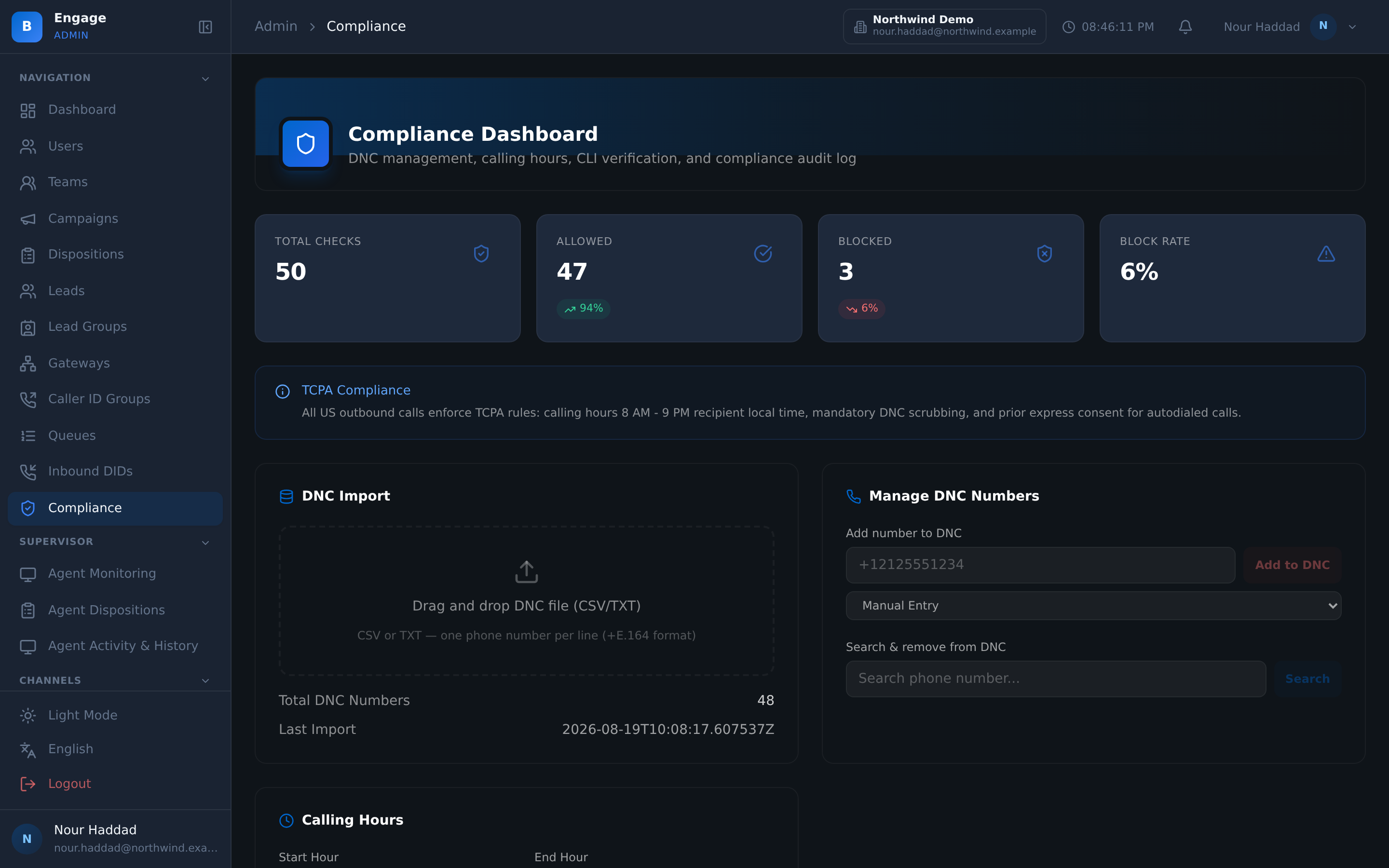
Compliance Autopilot runs at the attempt rather than at import. The do-not-call list is searched, the calling window for the jurisdiction is applied, the consent record is checked and a revocation takes effect on the next attempt, the caller ID's ownership is verified, and a frequency limit and a phone format rule catch the rest.
Where a person has to make an exception, the override is recorded with an audit trail, so the decision has a name and a time against it.
- Do-not-call searched at the dial, not at import
- Calling window applied per jurisdiction, with US time zones taken from the number
- Consent created, updated and revoked per contact, with type, source and timestamp
- Overrides recorded with an audit trail, and every dial decision written to the log
Frequently asked questions
Does DialerBee handle Gulf Arabic on Saudi campaigns?+
Yes. Arabic dialect handling covers Gulf, Levantine and Egyptian Arabic across AI answering machine detection, transcription and the Layla voice agent, and the agent desktop and admin console are RTL. Arabic is one of the 11 languages DialerBee supports.
Can we keep our own Saudi SIP trunks and numbers?+
Yes. BYOC connects the SIP trunks you already contract, or you can keep your own PBX or SBC and use DialerBee for campaign management, pacing, compliance gating, the agent desktop, supervisor tools and reporting on top of it. Patterns where the voice never leaves your own infrastructure carry no per-minute platform fee.
What calling hours does DialerBee apply for Saudi Arabia?+
The ones you configure. There is no published permitted-hours rule for outbound voice telemarketing in Saudi Arabia, and the 22:00 to 07:00 rule usually quoted belongs to the anti-spam regulation, whose definition of an electronic message excludes voice calls. Because the Kingdom publishes no voice window, the window you set is your own policy, and enforcing it in the platform makes it the same window on every campaign.
Is there a Saudi do-not-call register to scrub against?+
No national register appears in the published Saudi instruments, which is an absence of evidence rather than proof that none exists. What is established is an opt-out at the sender: a free, easy stop mechanism that halts sending immediately on request. DialerBee runs your own suppression list and checks it at the dial rather than at import.
Do you price in local currency?+
No. DialerBee publishes one price list in US dollars, per agent per month: Starter at $69, Professional at $129 and Enterprise custom. Annual billing saves 20 percent against monthly. Carrier minutes are billed by your own carrier rather than by DialerBee, so telecom spend stays on your existing contract with no markup from us.
Where is our data stored?+
Call recordings are stored in MinIO on private cloud infrastructure rather than third-party object storage, and structured data such as contacts, campaigns, compliance decisions and audit logs sits in PostgreSQL with row-level security on every tenant table. Storage locations and retention policies are configurable per tenant to meet jurisdiction requirements.
See DialerBee on your own Saudi Arabia numbers
A 30-minute walkthrough on a demo tenant, in English or Arabic.