AI Answering Machine Detection
More live conversations. In every language you dial.
Transcript-based AMD in 11 languages with dialect awareness, agent feedback loops, and tenant-scoped tuning. Classification is transcript-based rather than beep-based.
14-day free trial · no credit card required
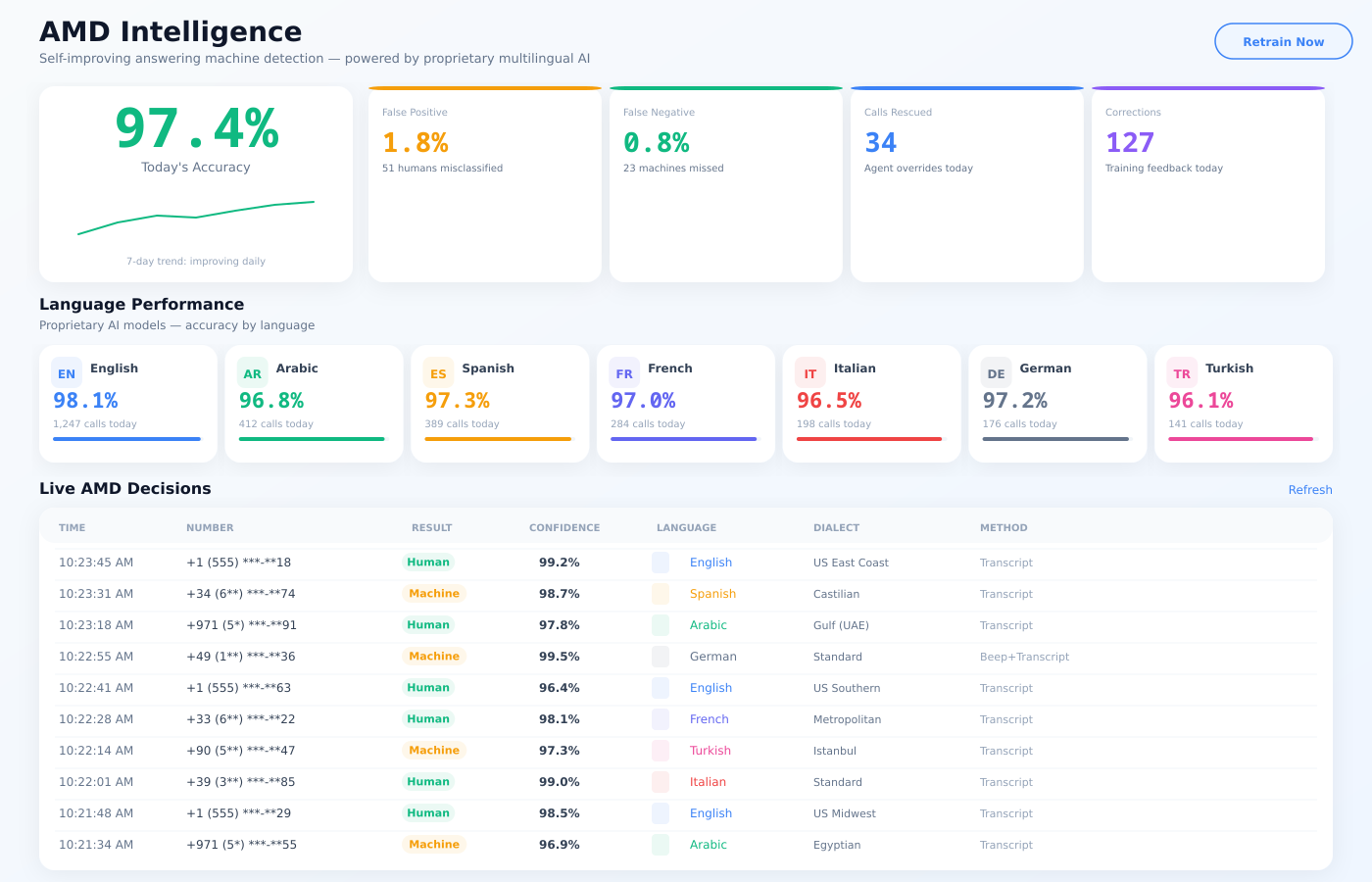
Illustrative dashboard. Accuracy figures are from internal pilot conditions and vary by carrier, language and list quality.
Real-time answering-machine decisions with confidence scores and per-campaign, per-language accuracy. View benchmark data →
Quick answer
What is AI Answering Machine Detection? AI AMD (Answering Machine Detection) is a technology used in outbound dialers to automatically determine whether a live human or an answering machine has picked up a call. Traditional AMD uses beep detection and silence patterns. DialerBee's AI AMD uses real-time transcript classification — it transcribes the first few seconds of audio and uses a machine learning model to classify the text as human or machine. It supports 11 languages (English, Arabic, Spanish, French, Italian, German, Turkish, Hindi, Urdu, Portuguese, Indonesian) with dialect awareness. Agent corrections feed tenant-scoped tuning workflows. Classifies from the transcript rather than waiting for a beep, so it works where voicemail systems play no tone."border-b border-slate-100 bg-white py-6">
The Problem
Traditional AMD costs you real conversations
Every outbound team has experienced this: a live prospect picks up the phone, says "Hello?" — and your dialer hangs up on them because the AMD system classified them as an answering machine. That's a false positive, and it's one of the most expensive mistakes in outbound operations.
Traditional AMD systems work by listening for beep tones and silence patterns. They detect the pause after a voicemail greeting ends and the beep that follows. The problem? This approach has no understanding of what's actually being said. It can't distinguish between a human saying "Hello, who's calling?" and a voicemail greeting that happens to have a similar timing pattern.
The result: false positive rates of 10-20% are common with beep-based AMD. That means for every 100 calls where someone picks up, 10-20 live humans get disconnected. Those are conversations — and revenue — that your team will never recover.
Why it matters
Fewer false positives, more live conversations
Every false positive is a live person your dialer hung up on — a conversation, and revenue, you never get back. Moving false positives from the 10–20% common with beep detection down to below 3% (in internal pilot conditions) means recovering the live calls a beep detector would have dropped. On a busy floor that adds up to thousands of extra live connections a month. Actual results vary by list quality, carrier, region, and language.
More live connects
Agents stop being dropped as "machines," so more real conversations happen per hour.
Less wasted time
Voicemail is filtered before your agent ever hears it — in every language you dial, not just English.
Clearer visibility
Accuracy broken out per campaign, carrier, and language — so you can prove what's working.
How It Works
Transcript classification, not audio guessing
DialerBee's AI AMD takes a fundamentally different approach. Instead of listening for beeps, it transcribes the first few seconds of call audio and classifies the resulting text using a purpose-built machine learning model. The model understands language — it knows that "Hello?" from a live person is different from "Hi, you've reached the voicemail of Sarah. I'm not available right now." — even across different languages and dialects.
Transcribe
The moment someone picks up, audio is transcribed in real time. The system reads actual words, not waveforms or silence patterns.
Detect Language
The model identifies the language and dialect automatically — Gulf Arabic, Mexican Spanish, Canadian French, Hindi, Urdu, and more.
Classify
A purpose-built ML classifier scores the transcript. Human or machine — returned with a confidence score the campaign threshold acts on.
Learn
Agent corrections feed tenant-scoped tuning workflows. The system improves over time for your specific carriers, regions, and campaign types.
Side-by-Side Comparison
AI AMD vs traditional beep detection
| Capability | Traditional Beep Detection | DialerBee AI AMD |
|---|---|---|
| How it works | Listens for silence + beep patterns | Transcribes and classifies actual words |
| Detection speed | 2-4 seconds | Under 1 second in pilot conditions |
| False positive rate | 10-20% (industry reports) | Below 3% in internal pilots |
| Languages | English only (pattern-based) | 11 languages with dialect awareness |
| Learning | Static rules, manual tuning | Agent feedback → tenant-scoped tuning |
| Carrier adaptation | None | Per-carrier pattern learning |
| Dialect handling | None | Regional dialect tuning per language |
| Analytics | Basic hit/miss counts | Per-campaign, per-carrier, per-language accuracy dashboards |
Performance data based on internal pilot benchmarks. Results vary by campaign type, carrier, region, and list quality. View full benchmark methodology.
Agent Feedback Loop
Your agents make the model smarter
Most AMD systems ship a static model that never improves. DialerBee's AI AMD includes an agent feedback loop that allows continuous improvement. When the model makes a mistake — classifying a live person as a machine, or vice versa — agents flag it with a single click. These corrections feed into tenant-scoped tuning workflows, meaning the system can improve specifically for your carriers, your regions, and your campaign types.
This feedback loop is what separates AI AMD from traditional detection. Over time, your AMD accuracy can improve without any manual intervention from your team — the agents are already providing the signal through their normal workflow.
One-Click Override
When the model gets it wrong, agents flag it with a single click during the call. No forms, no tickets, no disruption to their workflow.
Tenant-Scoped Tuning
Agent corrections feed tuning workflows scoped to your tenant only. Your feedback improves your accuracy. No cross-tenant data sharing.
Per-Carrier Patterns
Different carriers produce different voicemail greetings and audio characteristics. The model learns carrier-specific patterns for your market.
Fewer Dropped Humans
Because classification reads the transcript rather than waiting for a tone, a live greeting is recognised as a greeting even where no beep is played.
Classification During Pickup
The verdict is produced from the opening moments of the call, while the greeting is still playing — so the decision to connect or drop happens inside the pickup phase rather than after it.
Per-Campaign Analytics
AMD accuracy metrics broken down by campaign, carrier, language, and region. Full visibility into what's working and where to improve.
Multilingual AMD
AMD that understands your customers' language
Most AMD systems only work in English. If your team dials in Arabic, Spanish, French, or Hindi, traditional AMD either misclassifies everything or you disable it entirely — forcing agents to listen to voicemail greetings manually. DialerBee's AI AMD supports 11 languages with dialect awareness, so you get accurate detection regardless of which market you're calling.

English

Arabic

Spanish

French

Italian

German

Turkish

Hindi

Urdu
Each language includes dialect awareness. Arabic AMD handles Gulf, Levantine, Egyptian, and Maghreb variants. Spanish AMD covers Latin American and European dialects. Hindi and Urdu handle regional accent variations. Portuguese and Mandarin are in active development.
Use Cases
AI AMD for every outbound team
Collections
Filter voicemail on payment reminder campaigns. Agents spend time on live debtors, not voicemail boxes. Compliance-supporting controls help keep calls within regulations.
Sales Teams
Increase live connect rates for lead qualification and follow-up campaigns. AI AMD with local presence dialing maximizes the chance of reaching a live prospect.
BPOs
Per-tenant AMD tuning across multiple client campaigns. Each client gets their own accuracy metrics and feedback loop, isolated from other tenants.
Banking & Insurance
Detect answering machines on KYC follow-ups, policy renewals, fraud alert callbacks, and appointment confirmations. Audit-ready logging for every AMD decision.
MENA Operations
Arabic AMD with Gulf, Levantine, and Egyptian dialect awareness. The only AMD solution purpose-built for Arabic-speaking markets.
Telecom Resellers
White-label AI AMD as part of your dialer offering. Per-tenant isolation means each of your customers gets their own tuning and analytics.
Technical Specifications
Under the hood
| Detection method | Real-time transcript classification using purpose-built ML model |
| Audio processed | First few seconds of call audio after pickup |
| Classification speed | Under 1 second in internal pilot conditions |
| False positive rate | Below 3% in selected pilot conditions |
| Languages | 11: EN, AR, ES, FR, IT, DE, TR, HI, UR, PT, ID with dialect variants |
| Dialect support | Gulf/Levantine/Egyptian Arabic, LATAM/European Spanish, Canadian French, regional Hindi/Urdu |
| Agent feedback | One-click override → tenant-scoped tuning workflows |
| Carrier tuning | Per-carrier voicemail pattern learning |
| Analytics | Per-campaign, per-carrier, per-language accuracy dashboards |
| AI data privacy | AMD audio not stored long-term. Classification results retained. Tenant-isolated. |
| Opt-out | AI features can be disabled per tenant via feature flags |
| API access | AMD results available via REST API and webhooks (call.amd_result event) |
Related features
Call Transcription
Full call transcription in 11 languages with AI summaries and sentiment analysis.
Predictive Dialer
ML-driven pacing that pairs with AI AMD for maximum throughput.
Analytics & Reporting
AMD accuracy reports by campaign, language, and carrier.
AMD Comparison Guide
Detailed comparison of AI AMD vs traditional beep detection.
Voicemail Drop
What happens after AMD hears a machine: a template dropped in one click.
Frequently asked questions about AI AMD
What is AI Answering Machine Detection (AMD)?
How is DialerBee's AI AMD different from traditional beep detection?
What languages does AI AMD support?
What happens when AMD makes a wrong classification?
How fast does AI AMD classify a call?
Does AI AMD work with all carriers?
Can I disable AI AMD?
Is call audio stored for AMD processing?
See AI AMD classify a live call
Book a demo and watch the model detect answering machines in real time — in your language. Or start free and try it on your own list.
14-day free trial · no credit card · see pricing