Compliance Autopilot
The rule applies whether anyone remembers it or not
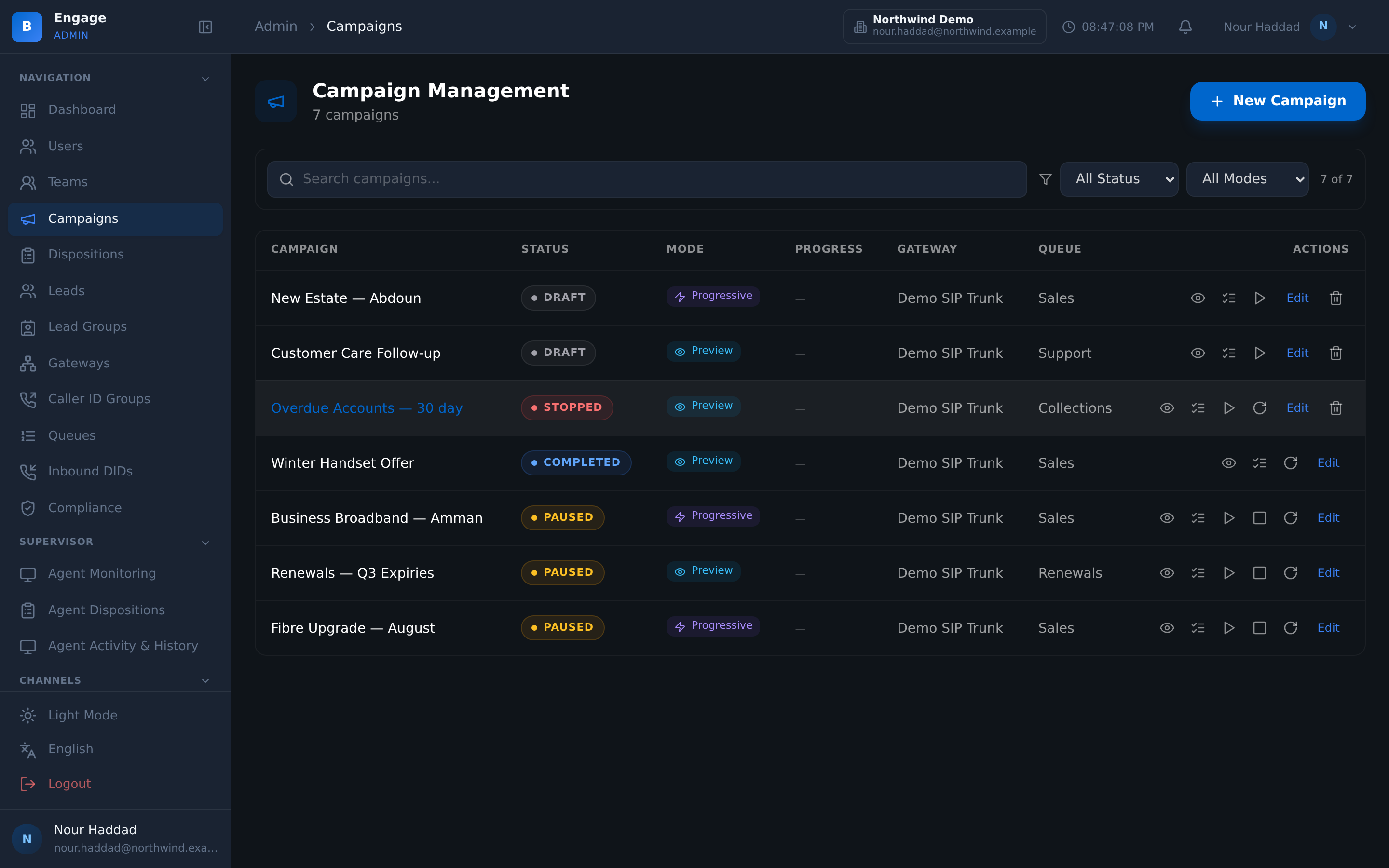
Every attempt is checked against the current DNC list, the calling window for its jurisdiction, the consent record, the caller ID's ownership, the frequency limit and the phone format. Jurisdiction packs for UAE, Saudi Arabia, Jordan, Bahrain and US time zones.
14-day free trial · no credit card required
Quick answer
What you get
Everything in one workspace
A check on every call
The rules run per call rather than per import, so today's list is judged against today's rules and not against the state of things when someone uploaded a file.
DNC checked at the dial
Import the do-not-call list once. It is then searched and checked on every attempt, so a number added this morning is caught this afternoon.
Calling hours enforced
The calling window for the jurisdiction is applied automatically, so nobody has to work out whether 6pm here is 6pm there.
US time zones from the number
For US calling the time zone follows the number, so a calling window means the customer's local evening rather than the agent's.
Consent checked, revocation honoured
Consent is recorded, updated and revoked as a record. A revocation takes effect on the next attempt rather than on the next list refresh.
CLI ownership enforced
A caller ID belongs to one tenant exclusively, so a number you are answerable for cannot be presented on another tenant's calls.
Frequency rule applied
Repeat attempts against the same contact are limited automatically. The complaint you are most likely to receive is about the fourth call, not the first.
Phone format rule
A malformed number in an imported list is caught by the format rule instead of being dialled and charged for.
Jurisdiction packs applied
UAE TDRA, KSA CITC, Jordan TRC and Bahrain TRA ship as packs. Set the pack and the rules that go with it apply to every call under it.
Overrides with an audit trail
When a person overrides a rule, the override is recorded. That is what turns an exception into something you can explain later.
Automatic
Nobody has to remember the rule
Compliance failures are rarely decisions. They are a supervisor who did not know the calling window in another country, an agent who redialled a number for the fourth time, a list that was clean when it was uploaded a fortnight ago.
Autopilot removes the remembering. Every attempt is checked against the DNC list, the calling-hours window for its jurisdiction, the consent record, the caller ID's ownership, the frequency limit and the phone format, without anyone doing anything.
- DNC searched and checked on every attempt, not at import
- Calling hours applied from the jurisdiction pack
- Consent checked before the attempt, revocation honoured immediately
- Frequency and phone format rules applied automatically
Across borders
The rule follows the number
A floor in Amman that calls the UAE, Saudi Arabia, Bahrain and the United States is running four rulebooks at once. Jurisdiction packs make that a setting rather than a memory test: UAE TDRA, KSA CITC, Jordan TRC and Bahrain TRA, plus US time zones taken from the number itself.
The UAE TDRA pack adds a two-year maximum on consent and a DNC sync, so a consent that has quietly aged past two years stops counting without anyone having to audit it.
- UAE TDRA, with a two-year consent maximum and DNC sync
- KSA CITC, Jordan TRC and Bahrain TRA
- US time zones derived from the number being called
- Caller IDs owned exclusively, per tenant
When a person overrules it
An exception you can explain
Real operations need exceptions. A supervisor who can never override a rule will find a way around the system instead, which is the worst of both outcomes.
So overrides exist, and every one is recorded with an audit trail. The exception stays visible, and you can answer a question about it months later. These are compliance-supporting controls that help you meet obligations under frameworks such as TCPA and GDPR. They do not replace your own counsel.
- Overrides available to the people who need them
- Every override recorded with an audit trail
- Consent create, update and revoke as auditable records
- Compliance-supporting controls that help you meet TCPA and GDPR obligations
How it compares
| Compliance somebody has to remember | Compliance Autopilot | |
|---|---|---|
| Who applies the rule | The supervisor, if they know it | The platform, on every attempt |
| DNC freshness | As fresh as the last import | Checked against the current list at the dial |
| Calling into four countries | Four rulebooks in someone's head | Four jurisdiction packs, applied per number |
| A revoked consent | Effective at the next list refresh | Effective on the next attempt |
| The fourth call to the same person | Nobody notices | Stopped by the frequency rule |
| A necessary exception | An undocumented decision | An override with an audit trail |
Frequently asked questions
What is Compliance Autopilot?+
It is the compliance rules running by themselves on every call. DNC, calling hours, consent, caller ID ownership, the frequency rule and the phone format rule are checked at the attempt, under the jurisdiction pack that applies to the number, without anyone having to invoke them.
Why does it matter that checks run per call?+
Because lists age. A contact list uploaded a fortnight ago was clean a fortnight ago. Checking at the attempt means a number added to your DNC list this morning is caught on this afternoon's call, and a consent revoked an hour ago is honoured on the next attempt rather than at the next refresh.
How does it handle calling into several countries at once?+
Through jurisdiction packs. UAE TDRA, KSA CITC, Jordan TRC and Bahrain TRA ship as packs, and US calling uses time zones taken from the number itself. The rule that applies follows the number being called rather than the location of the floor doing the calling.
What does the UAE TDRA pack add?+
A two-year maximum on consent and a DNC sync, on top of the standard checks. The consent maximum matters because consent ages quietly: without an expiry, a record collected three years ago keeps authorising calls until somebody notices.
What stops the same person being called repeatedly?+
The frequency rule, applied before the attempt. Most complaints are not about being called once, they are about being called again and again, and a frequency limit is the single control that prevents the pattern rather than apologising for it.
Can a supervisor override a block?+
Yes, and the override is recorded with an audit trail. A system that allows no exceptions gets worked around, which leaves you with neither the rule nor the record. An override that is written down leaves you with both.
Does this make my operation TCPA or GDPR compliant?+
No product can make that claim. These are compliance-supporting controls that help you meet obligations under frameworks such as TCPA and GDPR: consent records with revocation, DNC checking at the dial, calling-hour enforcement, frequency limits, caller ID ownership and audited overrides. Your own counsel remains the authority on your obligations.
What happens to a malformed number in an imported list?+
The phone format rule catches it before it is dialled. It is a small control with a direct cost saving: a badly formatted row that reaches the carrier is an attempt you pay for and a statistic that quietly distorts your connect rate.
Watch the checks run on a live attempt, on a demo tenant
A 30-minute walkthrough on a demo tenant, in English or Arabic.