Compliance
Rules that run at the call, not at the import
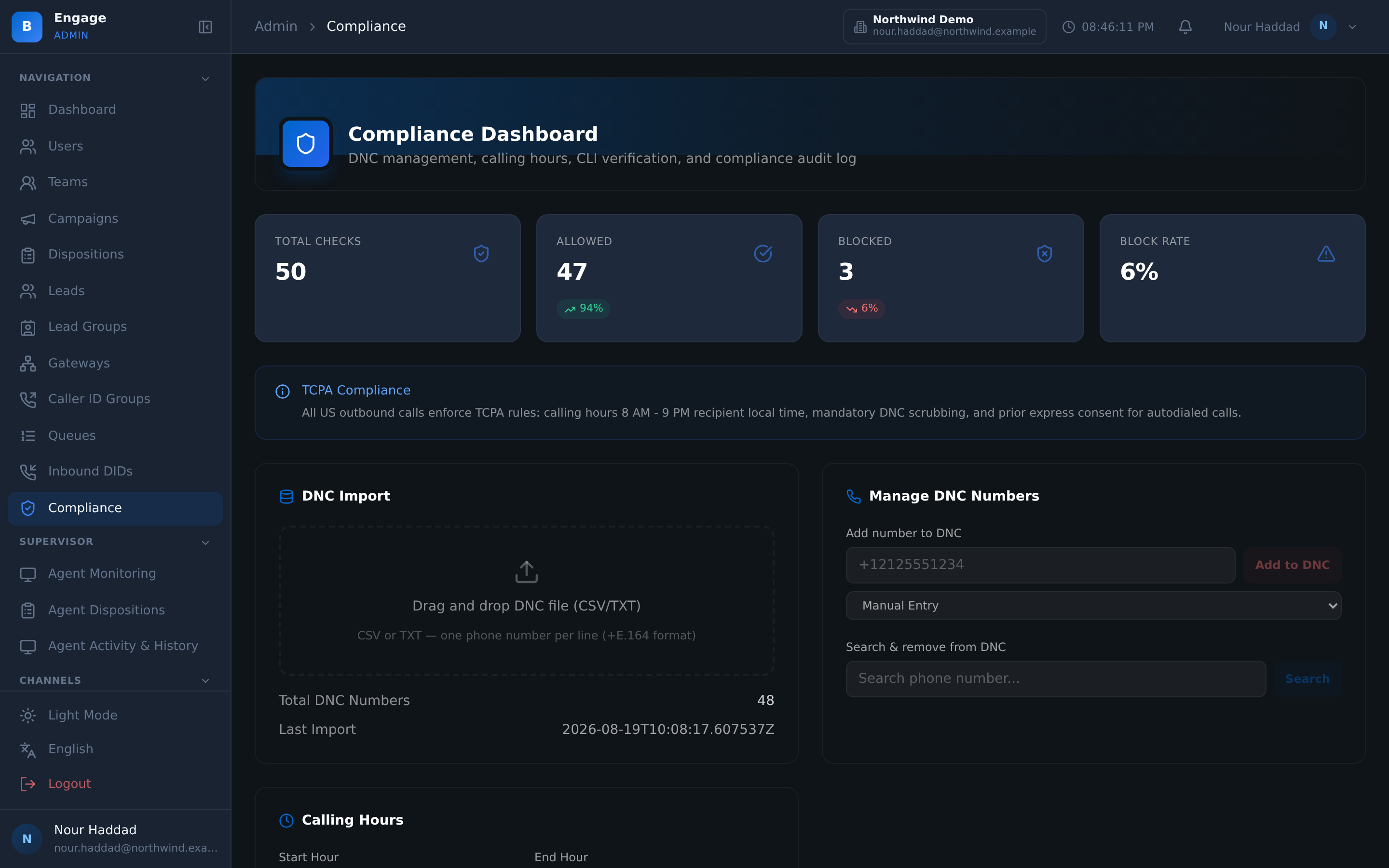
DNC checked against the current list on every call. Calling hours per jurisdiction. Consent you can record, update and revoke. Caller IDs owned exclusively by one tenant. Frequency and format rules. And every override written down.
14-day free trial · no credit card required
Quick answer
What you get
Everything in one workspace
DNC lists
Import a do-not-call list, search it, and check every call against it. A number added after the list was uploaded is still caught, because the check happens at the call.
Calling hours per jurisdiction
Calling windows set per jurisdiction rather than per campaign, so the rule follows the number being called instead of the team doing the calling.
Consent records
Record a consent, update it, and revoke it. Consent is a record with a history, not a checkbox somebody once ticked on a spreadsheet.
CLI exclusive ownership
A caller ID belongs to one tenant. Exclusive ownership is what stops a number you are responsible for appearing on somebody else's calls.
Frequency rule
A limit on how often the same contact can be attempted. Most complaints are not about being called, they are about being called again.
Phone format rule
Numbers are checked against the expected format before they are dialled, so a malformed row in an imported list is caught rather than dialled.
Overrides with audit
When a human has to override a rule, the override is recorded. An override nobody can see afterwards is indistinguishable from no rule at all.
Jurisdiction packs
UAE TDRA, KSA CITC, Jordan TRC and Bahrain TRA ship as packs, so a regional operation is configured from a pack rather than from memory.
US time zones
For US calling, the time zone follows the number, so a calling window means the customer's local time rather than yours.
The rules
Six checks, and the call is the moment they run
A compliance rule that runs at import time is a rule about a spreadsheet. These run per call: the DNC check, the calling-hours window, the consent record, the caller ID's ownership, the frequency limit and the phone format.
That timing is the whole point. A number added to your DNC list this morning is caught on this afternoon's call even though the contact list was uploaded last week.
- DNC with import, search and a per-call check
- Calling hours enforced per jurisdiction
- Consent record checked before the attempt
- CLI numbers with exclusive ownership
- A frequency rule and a phone format rule
Where you operate
UAE TDRA, KSA CITC, Jordan TRC, Bahrain TRA
Regional rules ship as jurisdiction packs rather than as advice. UAE TDRA carries a two-year maximum on consent and a DNC sync. KSA CITC, Jordan TRC and Bahrain TRA each configure their own calling windows and requirements. For US calling, time zones follow the number.
A pack matters most for an operation that dials several countries from one floor, where the rule that applies is a property of the number rather than of the campaign someone happened to put it in.
- UAE TDRA: two-year maximum on consent, with DNC sync
- KSA CITC
- Jordan TRC
- Bahrain TRA
- US time zones followed from the number being called
Consent and overrides
Revocation that sticks, and overrides you can see
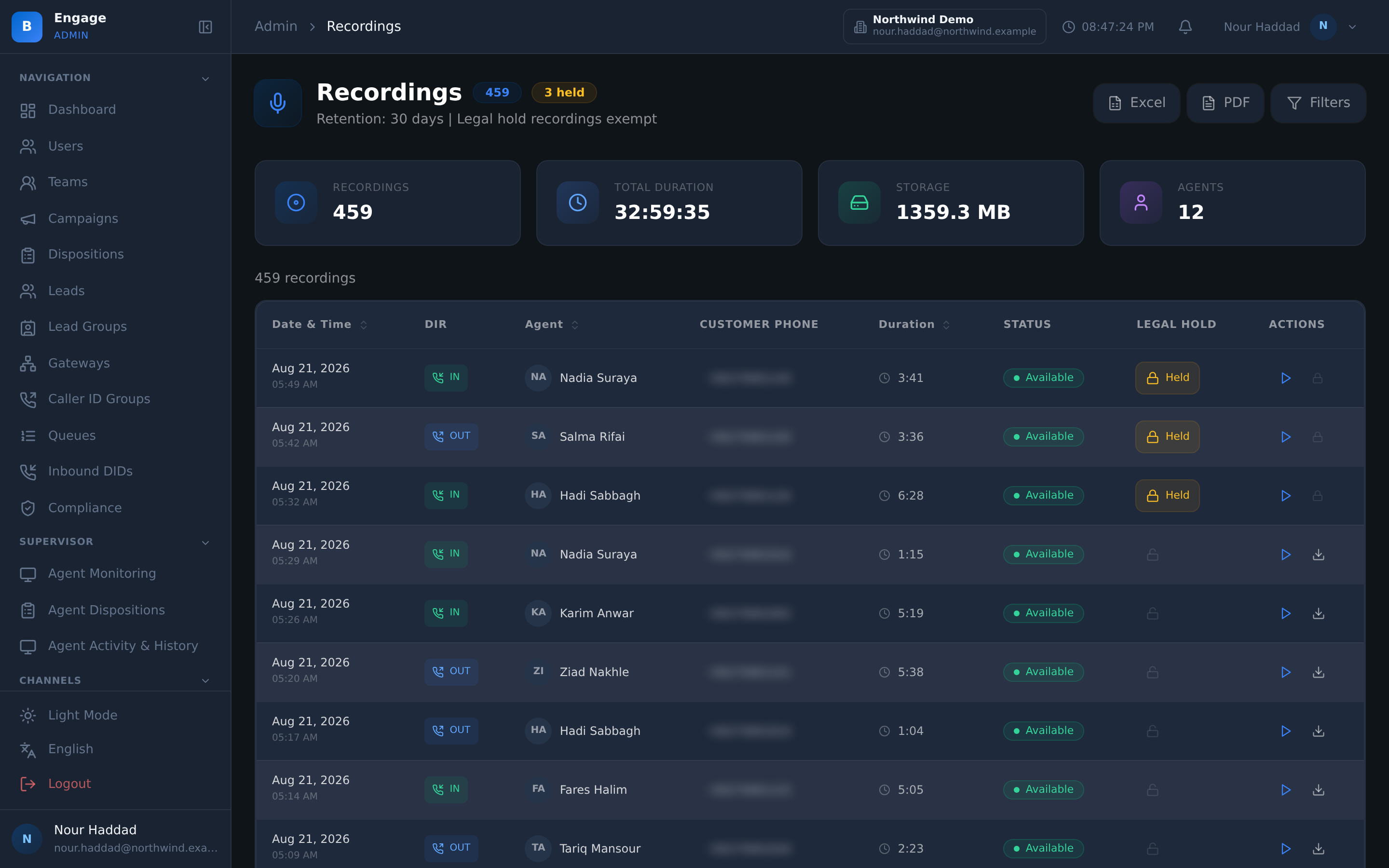
Consent can be recorded, updated and revoked, and a revocation is a first-class event rather than a deletion. Under the UAE TDRA pack, consent also expires: two years is the maximum, so a consent nobody has refreshed stops counting on its own.
Sometimes a person has to override a rule. The override is recorded with an audit trail, so the exception is visible to you and demonstrable to anyone who asks later.
These are compliance-supporting controls that help you meet obligations under frameworks such as TCPA and GDPR. They are controls, not legal advice, and your own counsel remains the authority on what your operation must do.
- Consent record, update and revoke
- Two-year consent maximum under the UAE TDRA pack
- DNC sync under the UAE TDRA pack
- Overrides recorded with an audit trail
- Compliance-supporting controls that help you meet TCPA and GDPR obligations
How it compares
| Compliance as a policy document | DialerBee compliance controls | |
|---|---|---|
| When the DNC list is checked | When the list was uploaded | On every call, against the current list |
| Calling hours | A note in the campaign brief | A window enforced per jurisdiction, with US time zones following the number |
| Consent | A column in a spreadsheet | A record you can create, update and revoke, with an expiry under the UAE TDRA pack |
| Caller ID | Whatever the trunk sends | A number with exclusive ownership by one tenant |
| Calling someone repeatedly | Nobody notices until they complain | A frequency rule applied before the attempt |
| An exception to the rules | Somebody made a decision | An override with an audit trail |
Frequently asked questions
What compliance controls does DialerBee provide?+
DNC lists with import, search and a per-call check; calling hours per jurisdiction; consent records you can create, update and revoke; caller IDs with exclusive ownership; a frequency rule; a phone format rule; and overrides recorded with an audit trail. Jurisdiction packs configure these for the market you are calling into.
Which jurisdictions ship as packs?+
UAE TDRA, KSA CITC, Jordan TRC and Bahrain TRA, plus US time zones for calling into the United States. The UAE TDRA pack also carries a two-year maximum on consent and a DNC sync.
When is the DNC list checked?+
At the call, not at the import. That distinction matters more than it sounds: a number added to your DNC list this morning will still be blocked on a list you uploaded last week. You can also import a list and search it directly when you need to answer a question about one number.
How does consent work?+
Consent is a record. You create it, update it and revoke it, and the revocation is an event rather than a row disappearing. Under the UAE TDRA pack consent also expires at two years, so a consent nobody has refreshed stops being valid without anyone having to remember it.
What is CLI exclusive ownership?+
A caller ID number belongs to one tenant and only that tenant may present it. On a shared platform that is what stops a number you are answerable for showing up on somebody else's calls, which is both a regulatory problem and a reputational one.
Does DialerBee make me TCPA or GDPR compliant?+
No product can do that. What DialerBee provides is compliance-supporting controls that help you meet obligations under frameworks such as TCPA and GDPR: consent records with revocation, DNC checking, calling-hour enforcement, frequency limits and an audit trail on overrides. Your own counsel remains the authority on what your operation must do.
Can someone override a compliance rule?+
Yes, and the override is recorded. Real operations occasionally need an exception, and an exception that is invisible afterwards is worse than no rule at all. The audit trail is what makes an override something you can explain rather than something you discover.
How are calling hours handled across countries?+
Calling hours are configured per jurisdiction, so the window follows the number being called rather than the location of the team dialling. For US numbers the time zone is taken from the number, which is the only way a calling window means the customer's evening rather than yours.
See a call blocked by a rule, on a demo tenant
A 30-minute walkthrough on a demo tenant, in English or Arabic.