Pakistan
AI call center software for Pakistan
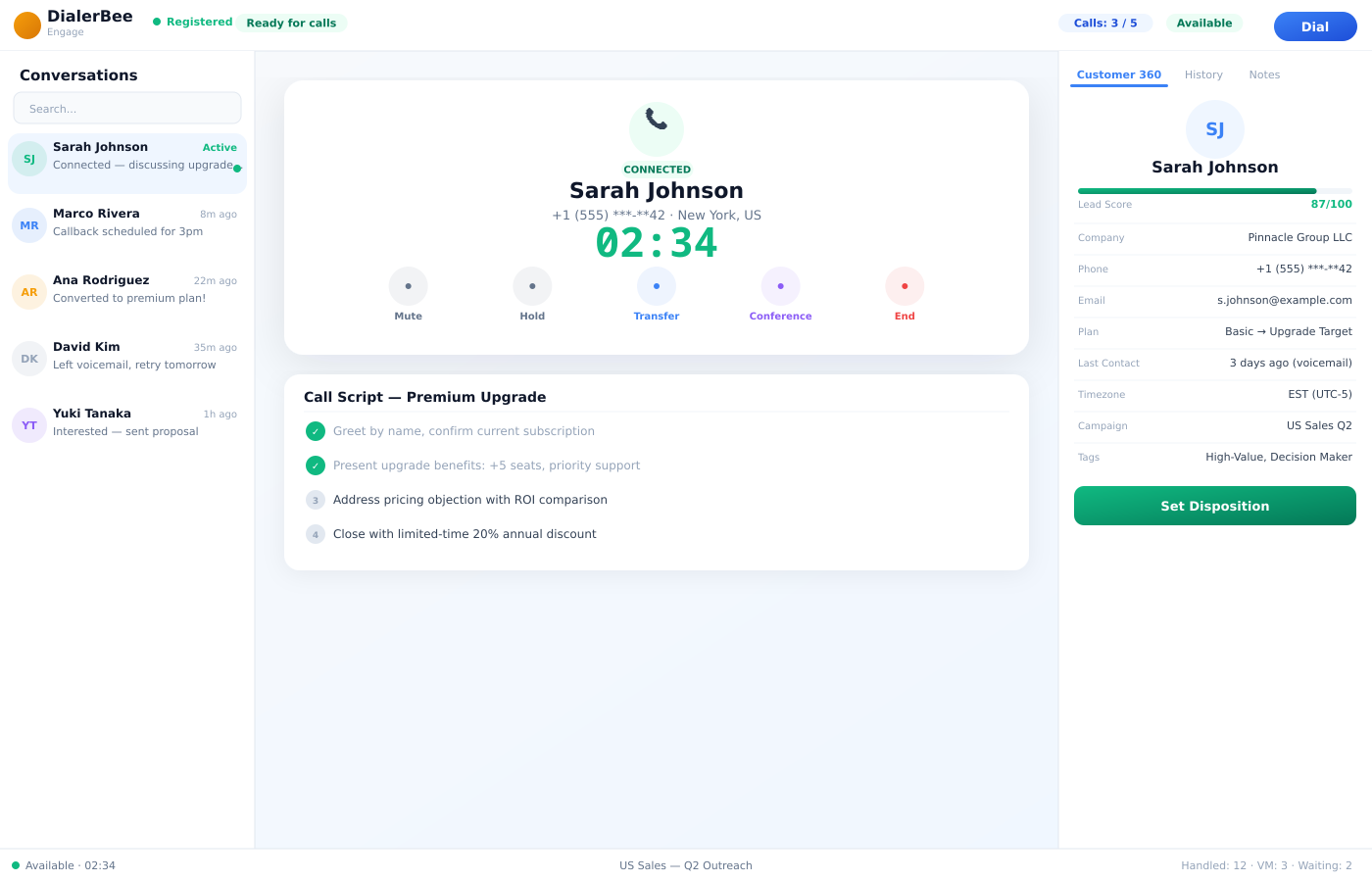
PTA tells a Pakistani telemarketer to take express consent in English and Urdu, keep the record, honour the 3627 register and call within “normal business hours”, then never says what those hours are. DialerBee turns each of those duties into a setting you can show, on the same floor that dials US, UK and Gulf clients at night.
14-day free trial · free AI credit to try the AI voice agent · no card needed
Quick answer
What you get
Everything in one workspace
A window for "normal business hours"
PTA's regulation 4(3) says marketing must reach subscribers within "normal business hours" and never defines the phrase. You pick the window, write down why, and DialerBee holds it per tenant and applies it before every attempt, so the decision is enforced and auditable rather than living in a spreadsheet.
Your consent record, because PTA says it is yours
The 2022 amendment puts the record of individual consent on the telemarketer, for use in any dispute. DialerBee stores consent per contact with type, source and timestamp, and a revocation takes effect on the next attempt, not the next list refresh.
The 3627 register, checked at the dial
Pakistan's Central Do Not Call Register covers calls and A2P promotional SMS, and subscribers join it by texting 3627. Import the numbers you get from your operator's access procedure and every attempt is searched against them, on voice and SMS alike.
Pre-recorded broadcast switched off
Regulation 6(A) allows robocalls only for public awareness required by PTA or the Government. Campaign modes are chosen per campaign and voicemail drop is enabled per campaign, so a Pakistani marketing campaign can run agent-answered dialing with both left off.
Urdu and English, as the regulations expect
PTA's prescribed consent message goes out in English and Urdu. Urdu is one of DialerBee's 11 languages for answering machine detection, transcription and the interface, the desktop renders Urdu right to left, and SMS segments are counted UCS-2 aware, so an Urdu text is priced correctly.
One tenant per export client
A Lahore or Karachi floor may dial Pakistani subscribers under PTA rules in the morning and US or Gulf numbers at night. Each client sits on its own tenant with its own rules, suppression list, caller IDs and branding, and the jurisdiction pack follows the number being dialed.
Local compliance
Who regulates telemarketing calls and SMS in Pakistan?
The Pakistan Telecommunication Authority (PTA), under the Protection from Spam, Unsolicited, Fraudulent and Obnoxious Communication Regulations, 2009, as amended in 2020 and again on 31 December 2022. The Prevention of Electronic Crimes Act, 2016 (PECA) adds the criminal side: direct marketing without an unsubscribe option can draw a fine of up to PKR 50,000 for a first breach and up to PKR 1 million for each later one, and presenting a counterfeit source is a separate offence. In practice the sanction that reaches a telemarketer first is disconnection by its operator, including after unsolicited calls made more than three times consecutively.
There is no direct application to PTA. Registration runs through the operators: a telemarketer contracts with a CVAS registration holder or mobile operator, the SLA is produced to PTA on demand, and marketing SMS goes out on PTA-allocated short codes or alphanumeric IDs. DialerBee sits on top of that arrangement under BYOC: you connect the SIP trunks and sender IDs you already contract, and the platform applies your rules to every attempt.
PTA rules and the DialerBee setting that supports each one
| What PTA or PECA says | What that means for a campaign | Where it lives in DialerBee |
|---|---|---|
| Communications within "normal business hours", undefined (reg. 4(3)) | You choose and document the window | Per-tenant calling window, applied before the call is originated |
| Express opt-in before marketing, sought in English and Urdu | No marketing call to a number without consent on file | Consent per contact with type, source and timestamp |
| Telemarketer keeps the consent record for disputes | Evidence must survive a complaint months later | Append-only audit log and auditor export |
| Central Do Not Call Register, joined by texting 3627, covers calls and A2P SMS | Screen voice and SMS against the same list | One suppression record shared by voice, WhatsApp and SMS |
| Robocalls only for public awareness (reg. 6(A)) | No pre-recorded commercial broadcast | Dialing mode and voicemail drop chosen per campaign |
| Unsubscribe option in every marketing message (PECA s. 22) | The opt-out route points at 3627 | Reviewed SMS template library under your own sender IDs |
| Counterfeit source is an offence (PECA s. 23) | Present only numbers you can prove are yours | Caller IDs owned by one tenant, with verified ownership per campaign |
| No recording-notice duty and no data-protection statute in force | Retention is a policy you must defend | Configurable retention, legal hold and per-tenant isolation |
What calling window should we use in Pakistan?
One you can explain. Because PTA never turns "normal business hours" into clock times, any window quoted to you as a PTA rule is not one. Pakistan Standard Time is UTC+5 nationwide and has not used daylight saving since 2009, so a single window covers the whole country and does not shift in spring or autumn.
The working week is not uniform either. Many offices work Monday to Friday, many private businesses also open on Saturday, and Friday is often shortened around the Jumu'ah prayer, so a consumer campaign and a business-to-business campaign may reasonably use different days. Holidays split into fixed national days and Islamic-calendar days that move each year:
| Fixed-date public holidays | Islamic-calendar public holidays (date moves yearly) |
|---|---|
| 5 February, Kashmir Day | Eid-ul-Fitr, 1 Shawwal, at the end of Ramadan |
| 23 March, Pakistan Day | Eid-ul-Adha, 10 Dhu al-Hijjah |
| 1 May, Labour Day; 28 May, Youm-e-Takbeer | Ashura, 9 and 10 Muharram |
| 14 August, Independence Day | Mawlid, 12 Rabi' al-Awwal |
| 9 November, Iqbal Day; 25 December, Quaid-e-Azam Day | Announced dates can depend on moon sighting, so confirm each year |
PTA's instruments carry no holiday restriction, so whether you dial on these days is your own policy. Whatever you decide, enter it once: holiday calendars are set per tenant and enforced by schedule gates on inbound, and the calling window is enforced per tenant on outbound.
Which languages do Pakistani callers use, and which does DialerBee cover?
Urdu is the national language and lingua franca, written right to left in Nastaliq, and English is co-official. Both are among DialerBee's 11 languages for AI answering machine detection, transcription and the interface, and the Urdu website translation exists too. Punjabi, Pashto, Sindhi and Saraiki are widely spoken at home but are not among the 11, so a Peshawar or interior Sindh campaign should plan for agents who speak the caller's language rather than for AI transcription in it. We would rather say that here than on your first week of calls.
What does DialerBee cost for a Pakistani floor?
Prices are in US dollars. The rupee floats, so we do not quote a PKR figure; convert at the rate on your invoice date. A worked example for a 20-seat export floor on Professional, which includes all four dialing modes, AI answering machine detection in 11 languages, supervisor tools and WhatsApp and SMS:
| Line | Monthly billing | Annual billing (20% less) |
|---|---|---|
| 20 Professional seats at $129 | $2,580 a month | $2,064 a month |
| Carrier minutes under BYOC | Billed by your carrier | Billed by your carrier |
| Optional AI voice agent, managed AI | $0.60 per started connected minute | $0.60 per started connected minute |
Starter is $69 per agent per month for up to 20 agents with preview and power dialing. Multi-tenant and white-label, which an outsourcer running several clients needs, sit on Enterprise, which is priced on request. There is a 14-day free trial with free AI credit and no card on your own SIP trunk, or book a demo and we walk through a Pakistani campaign setup with you.
Last reviewed October 22, 2026. Regulatory points are summarised from the Pakistan PTA compliance guide, which links the PTA gazette texts, PECA 2016 and the MoITT legislation register. Time zone, holidays, working week and languages are from public reference pages and vary by employer and year. This page is for operational education only and is not legal advice. DialerBee provides compliance-supporting controls and does not guarantee regulatory compliance. Confirm current rules with the Pakistan Telecommunication Authority, your operator and qualified counsel before you launch.
Domestic outbound
Built around PTA's consent and 3627 rules
Pakistan's rulebook is detailed about who may send and how a subscriber opts out. A telemarketer is registered through an operator or CVAS registration holder rather than directly with PTA, consent is express and taken before any marketing, and the prescribed opt-out points at the same short code, 3627, that runs the national do-not-call register.
In DialerBee those duties become settings you can show. Consent is created, updated and revoked per contact with its source and time. The do-not-call list is searched at the dial rather than at import. Every rule override is written to the audit log with a name and a time, which is the kind of evidence an operator or PTA can ask for when a complaint arrives through 3627, 420 or 9000.
- Consent records per contact: type, source, timestamp, revocation
- C-DNCR numbers imported once, then searched on every attempt
- Overrides recorded with an audit trail and auditor export
- Pre-recorded broadcast and voicemail drop left off per campaign
Inbound in Urdu
IVR and queues that start in Urdu
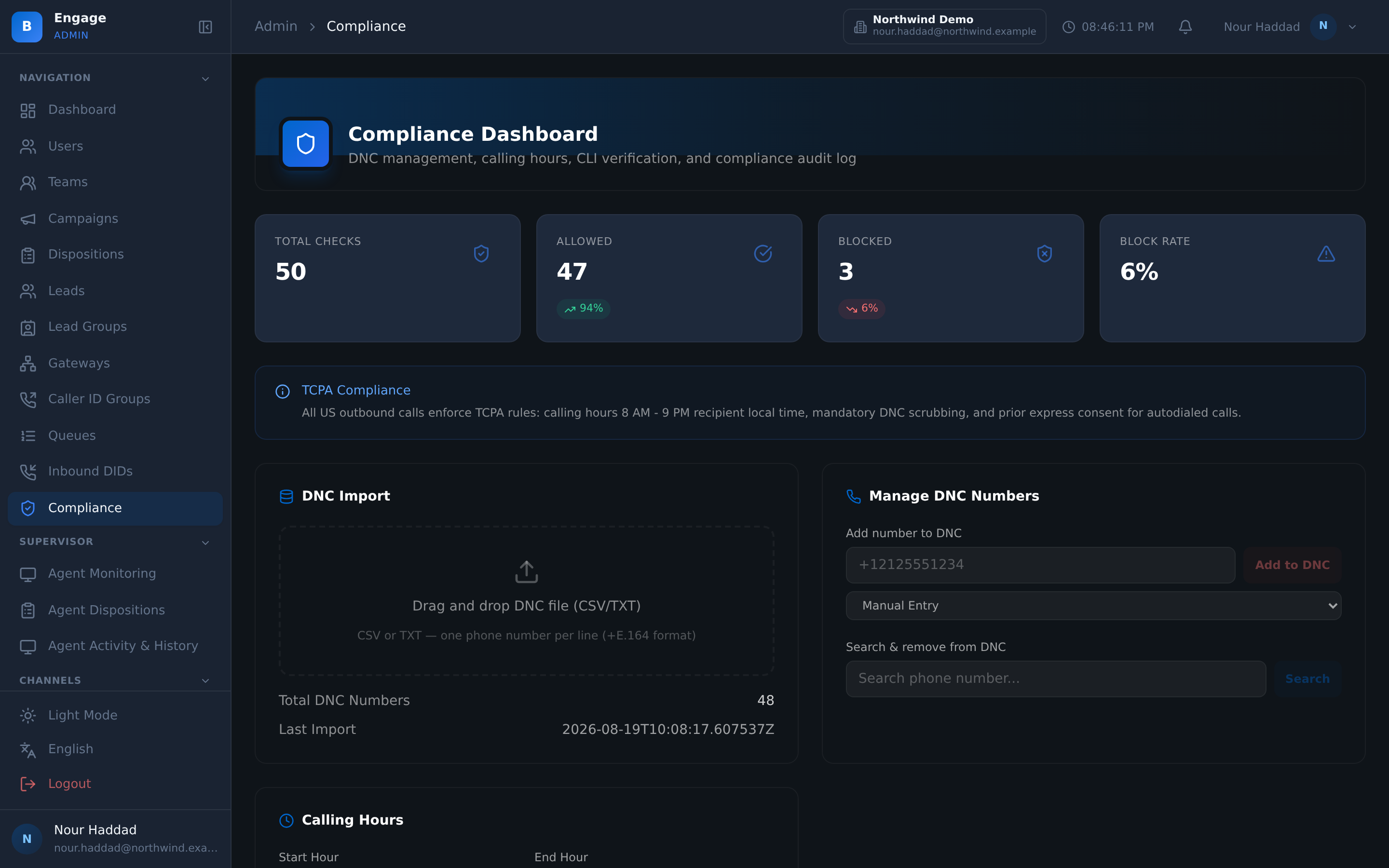
Urdu is the national language and English is co-official, so a Pakistani inbound line usually opens with a language choice. The IVR builder carries a language choice node, so the caller picks Urdu or English before they reach a queue, and prompts can be set in either language.
Holiday handling matters more here than in most markets, because Eid-ul-Fitr, Eid-ul-Adha, Ashura and Mawlid follow the Islamic calendar and move every year. Business-hours and holiday calendars are set per tenant and enforced by schedule gates, so the Eid closure is entered once and the out-of-hours announcement plays without anyone touching the routing.
- Language choice node: Urdu or English before the queue
- Holiday calendars per tenant for Eid, Ashura, Mawlid and the fixed national days
- Missed-call recovery: your own announcement, plus an SMS alert to a manager
- Urdu transcription and summaries on the recorded call
Export floors
A Pakistani floor, a foreign rulebook
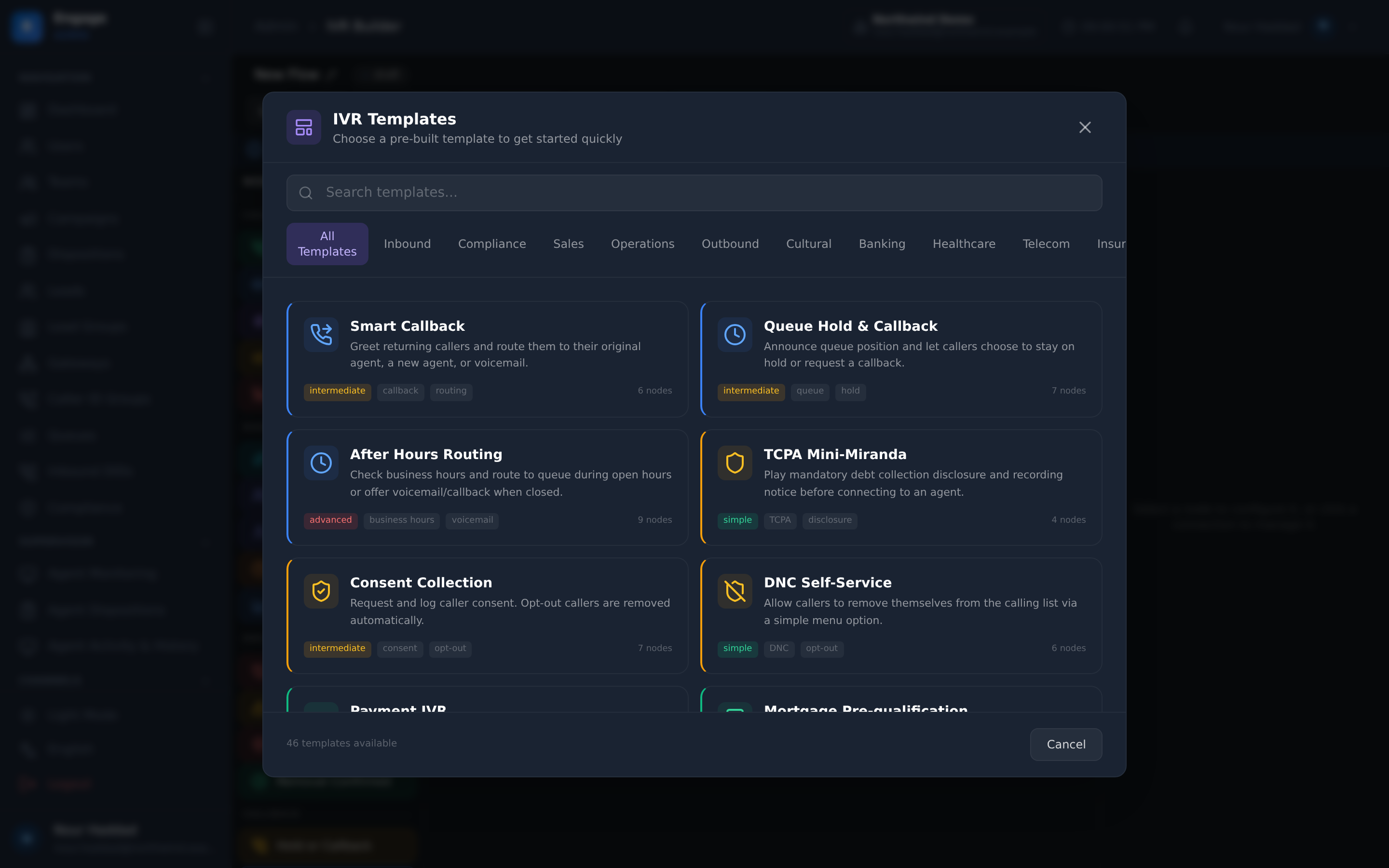
Pakistan Standard Time is UTC+5 all year, with no daylight saving since 2009. That makes US East Coast calling a night shift in Pakistan, nine hours behind in US summer and ten in winter, while UK numbers sit four or five hours behind and the UAE one hour behind. A floor that runs several of those at once needs the calling window to come from the number dialed, not from the clock on the wall in Karachi.
That is how DialerBee applies it. US calling takes its time zone from the number, jurisdiction packs ship for the UAE, Saudi Arabia, Jordan and Bahrain, and Pakistan itself is configured per tenant. One seat covers inbound and outbound, so the agent who takes a domestic Urdu queue call in the afternoon and dials a US campaign after midnight is billed once.
- Calling window taken from the destination number, not the floor
- Jurisdiction packs: UAE TDRA, KSA CST, Jordan TRC, Bahrain TRA
- Caller IDs owned by one tenant, so one client's number is never another's
- Browser WebRTC desktop, so a night shift needs no handset per seat
Frequently asked questions
What are the legal calling hours for telemarketing in Pakistan?+
PTA publishes none as clock hours. Regulation 4(3) of the 2009 anti-spam regulations, re-enacted in the 2022 amendment, says communications must reach subscribers within "normal business hours", and none of the 2009, 2020 or 2022 instruments defines the phrase, names a time zone or restricts days or public holidays. Pick a conservative window in Pakistan Standard Time (UTC+5), document the reasoning, and hold it in DialerBee's per-tenant calling window so it can change the day PTA publishes a definition.
How does DialerBee handle the 3627 do-not-call register?+
The Central Do Not Call Register is run by the operators, and registered telemarketers get access limited to the subscriber's number and area code through the operator's verification procedure. You import the numbers you obtain that way into DialerBee, and every call and SMS attempt is searched against them at the dial. Operators must update the register within two working days of a request and PTA sets no scrubbing frequency for you, so set your own refresh cadence.
Can we run robocalls or voicemail drops to Pakistani numbers?+
Not for marketing. The 2022 amendment's regulation 6(A) lets operators enable robocalls only for public awareness required by PTA or the Government of Pakistan. In DialerBee the dialing mode is chosen per campaign and voicemail drop is enabled per campaign, so a Pakistani marketing campaign can run preview, progressive, power or predictive dialing to live agents with pre-recorded delivery switched off. Confirm the treatment of any automated voice with your operator before launch.
Who keeps the consent record in Pakistan, and in what language?+
The telemarketer. The 2022 amendment states that the telemarketer shall keep the record of individual consent in case of any dispute, and that consent is sought by message in English and Urdu before marketing. DialerBee records consent per contact with type, source and timestamp, and a revocation applies on the next attempt. Urdu text is counted UCS-2 aware in the SMS composer, so a bilingual consent message is priced correctly.
Does Pakistan have a data protection law that applies to call recordings?+
Not in force as of October 2026. The Ministry of IT and Telecommunication lists Personal Data Protection Bills of 2018, 2020 and May 2023, each still marked "Draft", and no recording-notice duty appears in the PTA regulations or PECA sections 21 to 23. Announce recording anyway and choose a retention period you can justify. DialerBee supports that with configurable retention, legal hold and per-tenant isolation; these are compliance-supporting controls, not legal advice.
Does DialerBee support Urdu, Punjabi or Pashto?+
Urdu and English, yes: both are among the 11 languages for AI answering machine detection, transcription and the interface, and the agent desktop renders Urdu right to left. Punjabi, Pashto, Sindhi and Saraiki are not among the 11 languages, so calls in those languages are handled by your agents without AI transcription in that language. Layla, the AI voice agent, is built around Arabic dialects plus the other supported languages; ask on a demo before planning a Urdu voice-agent campaign.
How is DialerBee priced for a Pakistani BPO?+
In US dollars only, because the rupee floats and we do not publish a PKR price. Starter is $69 and Professional $129 per agent per month, Enterprise is custom, and annual billing saves 20 percent. A 20-seat Professional floor is $2,580 a month, or $2,064 a month on annual billing. Your Pakistani or international carrier bills minutes directly under BYOC, with no per-minute platform fee from DialerBee.
See DialerBee on your own Pakistan numbers
A 30-minute walkthrough on a demo tenant, in English or Arabic.