Egypt
AI call center software for Egypt
For Egyptian outsourcing floors, banks, telecom operators, collections teams and clinics that call from NTRA-registered lines, speak Egyptian Arabic, and need recording and consent handled the way Egyptian law reads, not the way a Gulf template assumes.
14-day free trial · free AI credit to try the AI voice agent · no card needed
Quick answer
What you get
Everything in one workspace
Present only lines registered for promotion
Since NTRA's rules of 21 July 2024, promotional and commercial calls must come from lines registered with the operators for that purpose. Caller-ID pools are owned by one tenant and mapped per campaign, so a campaign draws only from the registered numbers you put in its pool.
Ready for NTRA Alert on the handset
The person you call sees your registered entity's name and number, or an advance warning branded NTRA Alert, and since May 2025 that applies to fixed lines too. Keeping one tenant's numbers out of another tenant's campaigns keeps the name the recipient sees consistent with who is calling.
Frequency limits against nuisance complaints
NTRA enforcement is complaint-driven, through the 155 hotline, the My NTRA app and the operators. The frequency rule caps repeat attempts to the same contact before the call is placed, which is the pattern Article 76 of Law No. 10 of 2003 treats as harassment.
Recording that you can switch off or gate
A Court of Cassation ruling reported in July 2026 treats recording a call without judicial authorisation or the parties' written consent as an offence. Recording mode is set per queue and per campaign, so an Egyptian campaign can run unrecorded until your counsel signs off a consent process.
PDPL consent records kept three years
Law No. 151 of 2020 requires consent before electronic direct marketing and electronic records of it kept for three years from the last message sent. Consent is stored per contact with type, source and timestamp, and a revocation stops the next attempt.
A scheduler that knows Cairo changes its clock
Egypt runs UTC+2 in winter and UTC+3 in summer under Law No. 34 of 2023. Calling windows are configured per tenant and applied before the call is originated, so a window set for 10:00 Cairo time stays 10:00 Cairo time either side of the change.
Egyptian Arabic, not a generic Arabic voice
Arabic dialect handling covers Egyptian as well as Gulf and Levantine Arabic, across AI answering machine detection, transcription and Layla, the AI voice agent. English and nine more languages run on the same desktop for floors that serve clients abroad.
Local compliance
Who regulates outbound calling in Egypt?
Two bodies, on two separate tracks. The National Telecom Regulatory Authority (NTRA, الجهاز القومي لتنظيم الاتصالات) governs the lines: who may place promotional calls, from which numbers, and how they must identify themselves. The Personal Data Protection Centre, set up under Article 19 of the Personal Data Protection Law No. 151 of 2020, governs the data: consent for electronic marketing, licences and permits, data protection officers, breach notification and transfers abroad.
Egypt took a different route from its Gulf neighbours. Instead of a telemarketing code with fixed hours and a national opt-out list, NTRA built an identification and enforcement regime: register the line you call from, show who you are, and lose the line, then the handset, then the right to hold any line at all if you do not. For voice calls the rule is registration and identification rather than per-consumer opt-in; for SMS and other electronic marketing the PDPL is opt-in.
The data track became operational recently. The PDPL's Executive Regulations were issued as MCIT Decision No. 816 of 2025, and January 2026 was reported as the start of full implementation, with the Centre licensing, investigating and sanctioning.
At a glance
Egypt's calling rules, and the DialerBee control for each
Every rule below is summarised from our Egypt NTRA compliance guide, which cites its sources. Most rest on published reporting of NTRA statements, because NTRA's own site and the Official Gazette were not reachable when the guide was written.
| Topic | Position in Egypt | What DialerBee does |
|---|---|---|
| Calling line | Must be registered with the operator for promotional use, with the activity type declared (rules of 21 July 2024); fixed lines included | Tenant-owned caller-ID pools mapped per campaign |
| Caller identity | Recipient sees the entity's name and number or an "NTRA Alert" warning; extended to fixed lines in May 2025 | Exclusive number ownership per tenant, so the displayed entity matches the caller |
| Calling hours | No rule for marketing calls could be confirmed | Window configured per tenant, applied in Cairo local time |
| Time zone | UTC+2 in winter, UTC+3 in summer (Law No. 34 of 2023) | Scheduler works from the zone, not a fixed offset |
| Do-not-call | No national register found; complaints via 155, My NTRA and the operators; *155# cancels promotional subscriptions | Your suppression list, checked at every attempt |
| Consent for SMS and electronic marketing | Opt-in under PDPL Articles 17 and 18; records kept three years from the last message | Consent per contact with type, source and timestamp; revocation stops the next attempt |
| Call recording | Needs judicial authorisation or the parties' written consent (Court of Cassation, reported July 2026) | Recording set per queue and per campaign; retention, signed-URL playback, legal hold |
| Data leaving Egypt | PDPL Article 14: adequate protection plus a Centre licence or permit | Storage location and retention configurable per tenant |
| Penalties | Law 10/2003 Art. 76: EGP 500 to 20,000 and/or prison. Law 175/2018 Art. 25: EGP 50,000 to 100,000 and/or at least six months. PDPL: fines up to EGP 5,000,000 | Audit log of every dial decision and override |
Egypt does not ship as a DialerBee jurisdiction pack (packs exist for the UAE, Saudi Arabia, Jordan and Bahrain), because the two rules a pack would enforce, a calling window and a national do-not-call list, could not be confirmed for Egypt. The same per-attempt checks run; you set the values.
Clock and calendar
When do Egyptian contact centres call?
The clock moves twice a year. Egypt reintroduced summer time under Law No. 34 of 2023: clocks go to UTC+3 at midnight on the last Friday of April and back to UTC+2 at the end of the last Thursday of October. That puts the next changes at the end of Thursday 29 October 2026 and on Friday 30 April 2027. A dialer that stores "UTC+2" for Egypt calls an hour early or late for half the year; DialerBee applies each tenant's window against the zone before the call is originated.
The week runs Sunday to Thursday. Friday is the official rest day for government, and many banks and institutions also close on Saturday, while some private businesses and shops rest on Sunday instead. A campaign aimed at businesses usually needs a different weekly pattern from one aimed at consumers, so windows and business-hours calendars are set per tenant and per campaign rather than once for the country.
Holidays follow two calendars. Fixed public holidays include Coptic Christmas (7 January), Revolution Day and National Police Day (25 January), Sinai Liberation Day (25 April), Labour Day (1 May), 30 June Day, Revolution Day (23 July) and Armed Forces Day (6 October). Sham El Nessim, Islamic New Year, the Prophet's Birthday, Eid al-Fitr and Eid al-Adha move with the lunar or church calendar each year. Holiday calendars are entered per tenant and enforced by schedule gates on inbound, so a queue plays your own out-of-hours announcement on Eid without anyone remembering to change it.
Ramadan reshapes the day. No Ramadan-specific calling restriction appears in the sources behind our NTRA guide, so this is an operational choice rather than a legal one. Ramadan 2027 is expected in February and March, depending on the moon sighting, and many teams shorten or move their outbound windows around iftar. Because windows are per campaign, you can run a Ramadan schedule for Egyptian consumers without touching campaigns dialling clients abroad.
Use cases
What Egyptian teams run on it
Outsourcing floors serving clients abroad. One tenant per client, each with its own language mix, numbers and recording policy, on the same browser-based agent desktop. Egyptian Arabic for local work and English, French, German, Italian, Spanish or Turkish for export work, all among the 11 supported languages. See BPO contact centers.
Banks and collections. Payment reminders and KYC follow-ups from registered lines, with a frequency limit so a borrower is not called again and again, which is the behaviour Egypt's nuisance-call statute targets. A follow-up SMS counted correctly in UCS-2 Arabic. See banking and collections.
Telecom operators and resellers. Inbound queues with SLA targets, IVR self-service in Arabic, and multi-tenant white-label for a reseller serving its own business customers. See telecom operators.
Clinics and appointment businesses. Layla, the AI voice agent, answers in Egyptian Arabic, books or reschedules after a free-busy check, quotes only your own prices and hands off to a person. It covers appointment booking, FAQs and handoff only, never medical advice. See the AI receptionist and the Arabic AI voice agent.
Pricing in practice
What does a 20-seat Egyptian floor cost?
DialerBee prices in US dollars only. The Egyptian pound floats, so we do not quote an EGP figure that would be out of date within weeks. The worked example below uses published list prices.
| Item | Assumption | Monthly cost (USD) |
|---|---|---|
| Professional seats, monthly billing | 20 agents × $129 | $2,580 |
| Professional seats, annual billing | 20 percent off: 20 × $103.20 | $2,064 |
| Layla, AI voice agent (optional) | 2,000 connected minutes × $0.60 on managed AI | $1,200 |
| Carrier minutes | Your own Egyptian SIP trunks (BYOC) | Billed by your carrier, no DialerBee markup |
The 2,000-minute figure is an illustration, not a forecast. With your own model keys, a flat monthly fee replaces the per-minute AI rate. Self-serve sign-up needs your own SIP trunk or PBX; if you want BroadNet to provide numbers and trunks instead, that goes through sales. New tenants get a 14-day free trial with free AI credit and no card. See pricing, start a trial or book a demo.
DialerBee also lists a presence in Cairo on its contact page. This page is for operational education only and is not legal advice. Regulations change, and DialerBee provides compliance-supporting controls, and legal responsibility stays with the operator. Confirm current rules with the National Telecom Regulatory Authority (NTRA), the Personal Data Protection Centre and qualified counsel before you launch.
Registered lines
Built for a regime that polices the caller, not the list
In the UAE, compliance starts with a national do-not-call register and a fixed calling window. Egypt starts with the line. Since July 2024, anyone placing promotional or commercial calls has had to register their particulars and their numbers with the mobile operators and declare the type of promotional activity, and the duty covers fixed lines as well as mobile. Reporting cited in the NTRA guide put registrations at roughly one million lines in the first year.
The penalty ladder is what makes this operational rather than paperwork. A handset that calls from an unregistered line more than once is stopped; switching to other unregistered lines gets it blocked from every Egyptian network; and a subscriber proven to have used unregistered lines can be barred from holding any new line, personal ones included. Disconnections began on 24 August 2025. For a contact centre, the one mistake to engineer out is a campaign quietly falling back to a number nobody registered.
- Caller-ID pools owned by one tenant, so a registered number cannot be presented by another client
- Each campaign draws from its own pool, with its selection mode applied at dial time
- Your own suppression list checked at every attempt, since no national register was found to scrub against
- Every dial decision and every override written to the audit log for the day NTRA asks
Recording
Egypt is the strictest market for call recording
Most markets treat recording as a notice question: play an announcement and carry on. Egypt treats it as a privacy offence. Per a Court of Cassation ruling reported by Sada El Balad on 28 July 2026, recording a telephone call without prior judicial authorisation or the written consent of the parties violates the sanctity of private life, is punishable by up to one year's imprisonment with confiscation of equipment, and the recordings are in principle inadmissible. An announcement alone has not been confirmed as sufficient.
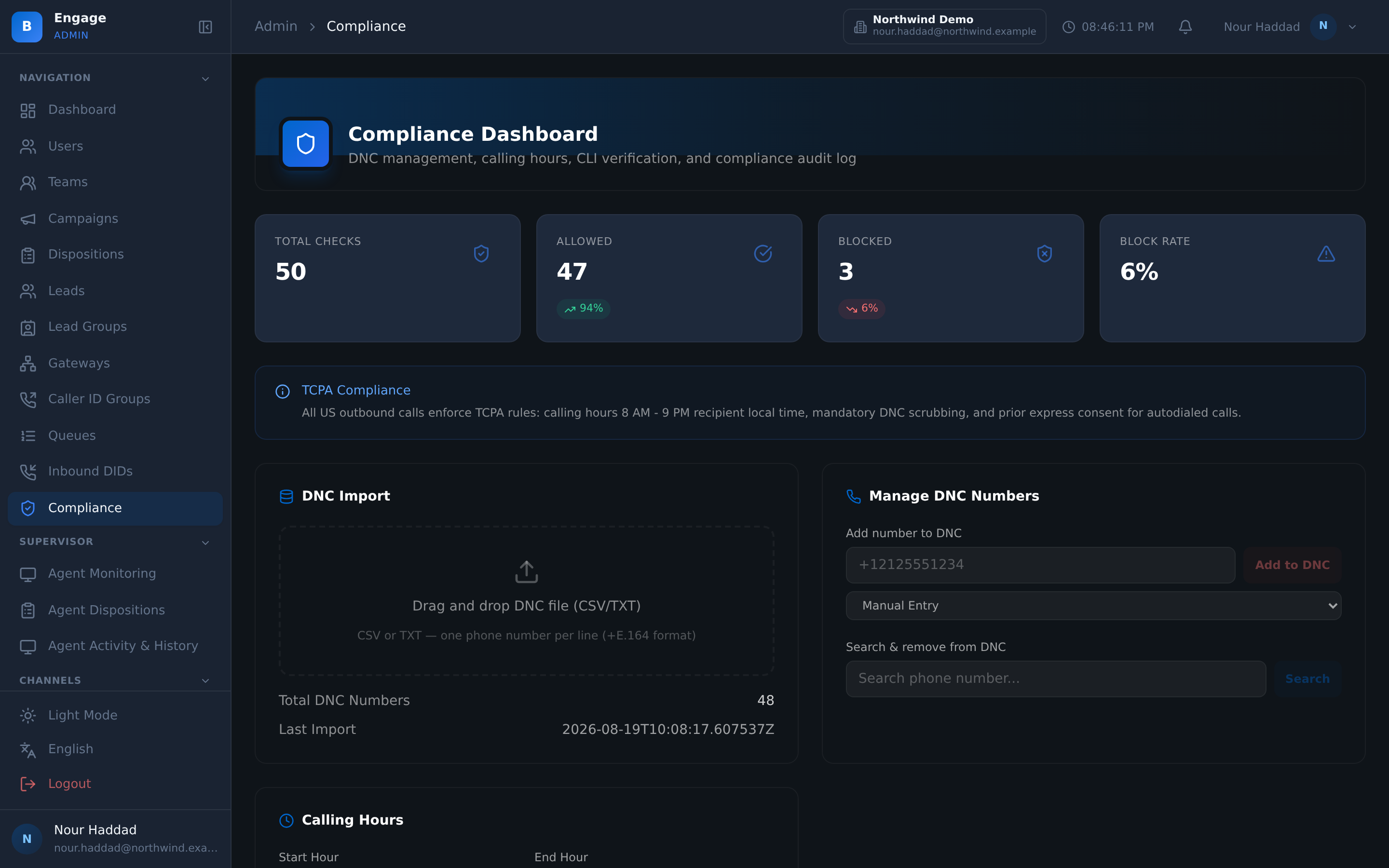
That changes how an Egyptian floor should be set up. Recording mode is a setting on each queue and each campaign rather than a platform-wide default, so you can leave Egyptian outbound unrecorded while your counsel decides how written consent is collected, and keep recording on for a client abroad whose rules differ.
- Recording on or off per queue and per campaign, not one switch for the whole tenant
- Configurable announcement where your policy uses one alongside written consent
- Retention set per tenant and per campaign, with legal hold for disputes
- Time-limited signed-URL playback, with access logged
Outsourcing floors
One tenant per client for Egypt's offshoring sector
Egypt sells contact-centre and IT services abroad as national policy: ITIDA, the government's IT industry agency, runs a Digital Egypt Vision for Offshoring 2022 to 2026 that aims to triple offshoring revenues, and promotes the country's multilingual talent. A floor in Cairo or Alexandria may take Egyptian Arabic calls for a local bank in the morning and English or French calls for a European client in the afternoon.
DialerBee is multi-tenant and white-label, so each client sits on its own tenant with its own caller IDs, suppression lists, calling windows, recording settings and reporting. That separation also matters for data: PDPL Article 14 prohibits transferring personal data out of Egypt unless the destination's protection is no lower than the PDPL's and a licence or permit from the Personal Data Protection Centre is held. Storage locations and retention are configurable per tenant, so the question of where an Egyptian client's data sits is answered per client rather than once for the whole floor.
- Row-level tenant isolation in every service
- Per-client caller IDs, suppression lists, calling windows and branding
- Egyptian Arabic, English and French among 11 languages on one agent desktop
- Storage location and retention configurable per tenant, for PDPL transfer planning
Frequently asked questions
Do we have to register our numbers with NTRA before running campaigns in Egypt?+
Under the NTRA rules approved on 21 July 2024, anyone making promotional or commercial calls must register their particulars and numbers with the mobile operators, activate the promotional-calls service and declare the type of activity, and reporting from August 2025 says fixed lines are covered too. DialerBee does not register lines for you; it makes sure each campaign presents only the numbers in its own tenant-owned pool.
What calling hours apply to marketing calls in Egypt?+
No permitted or prohibited calling-hours rule for marketing calls could be confirmed from any reachable source, and NTRA's published measures concern who may call and how they identify themselves rather than when. Egypt does not ship as a DialerBee jurisdiction pack, so you set the window per tenant, and the scheduler follows Cairo local time across the UTC+2 and UTC+3 change.
When does Egypt change its clocks, and does the dialer follow?+
Under Law No. 34 of 2023, summer time starts at midnight on the last Friday of April and ends at the end of the last Thursday of October. In 2026 it ends at the end of Thursday 29 October, and in 2027 it starts on Friday 30 April. Calling windows are applied against the zone before each call, not against a fixed offset.
Is there an Egyptian do-not-call register DialerBee can sync?+
None was found, and no source positively states that none exists, so there is nothing to sync and nothing to assume. Consumers report nuisance calls through the operators, NTRA's 155 hotline and the My NTRA app, and can cancel promotional subscriptions with the free code *155#. Your own suppression list is the practical control, and DialerBee checks it at every attempt rather than at import.
Can we record calls with Egyptian customers?+
Only with prior judicial authorisation or the parties' written consent, per a Court of Cassation ruling reported on 28 July 2026, and an announcement alone has not been confirmed as enough. That is a decision for your counsel. DialerBee lets you set recording per queue and per campaign, so Egyptian campaigns can run unrecorded while recording stays on elsewhere.
Does Egypt's data protection law affect SMS and WhatsApp campaigns?+
Yes. The Personal Data Protection Law No. 151 of 2020, with Executive Regulations issued as MCIT Decision No. 816 of 2025, requires consent for electronic direct marketing, sender identity, a clear marketing purpose, an easy way to refuse, and consent records kept for three years from the last message. DialerBee's controls are compliance-supporting, not a guarantee.
Does the AI voice agent speak Egyptian Arabic?+
Yes. Layla handles Gulf, Levantine and Egyptian Arabic plus ten more languages, answering inbound calls from a DID, running outbound AI campaigns, booking after a free-busy check, quoting only prices from your own catalogue and handing off to a human agent. The managed rate is $0.60 per started connected minute, an add-on on Professional and Enterprise.
Can we pay in Egyptian pounds?+
No. DialerBee publishes one price list in US dollars, and because the Egyptian pound floats we do not quote an EGP figure. Starter is $69 and Professional $129 per agent per month, with 20 percent off for annual billing. Carrier minutes on your own Egyptian trunks are billed by your carrier, with no DialerBee markup.
See DialerBee on your own registered Egyptian numbers
A 30-minute walkthrough on a demo tenant, in English or Arabic.